
What Is a T-Shaped Marketer? Rand Fishkin's Moz Model and the Skills It Takes

A T-shaped marketer knows a little about a lot of marketing channels and a lot about one or two. The horizontal bar of the T is breadth: enough working knowledge of SEO, content, social, email, paid ads and analytics to plan with the people who do them. The vertical bar is depth: the one skill you are truly good at. Rand Fishkin made the term popular in marketing in 2013 with his post The T-Shaped Web Marketer, written while he ran Moz.
We've already discussed the different roles in a Growth Hacking Team Structure, like creating content, making sure websites show up on Google, and handling social media. But leading such a team needs someone who understands all these areas and often also excels in one, two or a couple of these skills. It all depends on how much work you’re willing to put into becoming a master of some.
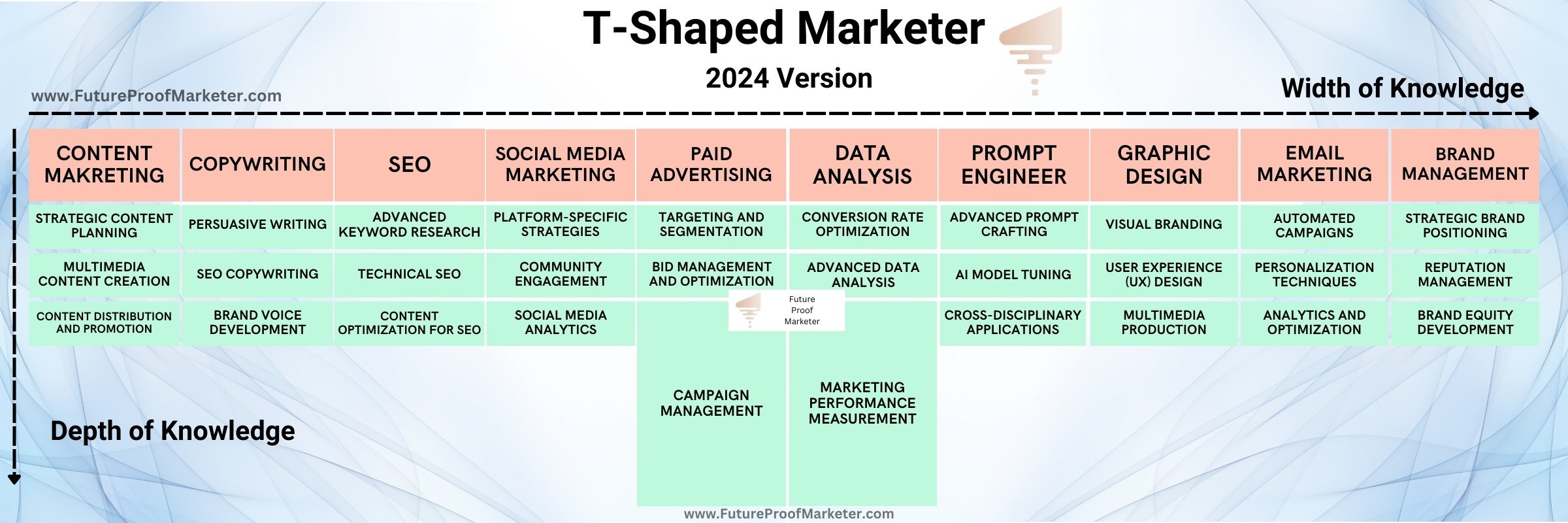
Where does the T-shaped marketer come from?
The T-shaped marketer as most people know it comes from Rand Fishkin. In September 2013, while he was CEO of Moz, he published a post called The T-Shaped Web Marketer. His diagram showed a wide horizontal bar of basic knowledge across overlapping disciplines, such as email, PPC, social and blogging, and a deep vertical bar in one field. For Fishkin, that deep bar was SEO. His point: marketers with this shape collaborate better, because they understand what their colleagues do. The post is now archived on the SparkToro blog.
The T-shape itself is older than web marketing. McKinsey used the term internally in the 1980s when recruiting consultants. In 1991, David Guest wrote about the hunt for T-shaped people in computing in The Independent. Later, IDEO's Tim Brown made it famous by hiring T-shaped designers. Fishkin took that idea and applied it to the marketing team.
What is T-shaped marketing?
T-Shaped marketing is a concept used to describe a person with a broad set of knowledge and skills across a wide range of marketing disciplines (the horizontal bar of the "T"), combined with deep expertise in one or a few specific areas (the vertical bar of the "T"). This model emphasizes the importance of having a versatile skill set in the digital marketing landscape, allowing marketers to understand and contribute to a variety of tasks while also possessing the ability to dive deep into specialized areas when needed.
T-Shaped marketers are highly valued for their flexibility, adaptability, and comprehensive understanding of marketing. They can effectively collaborate across different teams and projects, leveraging their broad knowledge to provide insights and drive strategies, while also applying their deep expertise to solve complex problems or optimize specific aspects of a marketing campaign. This approach enables them to contribute to the growth and success of a business in a multifaceted way.
Here are some of the skills a T-shaped Growth Marketer might possess. Remember that they’re usually able to excel in at least one of these skills.
1. Content Marketing Specialist
- Strategic Content Planning: Ability to develop a comprehensive content strategy that aligns with business goals and addresses customer needs across the buyer's journey.
- Multimedia Content Creation: Specialization in creating diverse content types, including video, infographics, e-books, and podcasts, to engage different segments of the audience. (AI has collapsed the cost of this skill — see the AI video tools we field-test.)
- Content Distribution and Promotion: Expertise in leveraging various channels effectively for content distribution and promotion to maximize reach and engagement.
2. Copywriter
- Persuasive Writing: Mastery in crafting compelling messages that motivate readers to take action, leveraging psychological triggers and emotional appeals.
- SEO Copywriting: Expertise in writing content that ranks well in search engine results while engaging the reader, including the strategic use of keywords and understanding search intent.
- Brand Voice Development: Ability to define and consistently apply a unique brand voice across all content, enhancing brand identity and recognition.
3. SEO Specialist
- Advanced Keyword Research: Mastery in identifying high-opportunity keywords using sophisticated tools and techniques.
- Technical SEO: Deep understanding of website architecture, mobile optimization, site speed enhancements, and structured data.
- Content Optimization for SEO: Expertise in optimizing content for search engines, including the use of meta tags, headers, and SEO-friendly content structures.
4. Social Media Strategist
- Platform-Specific Strategies: Deep understanding of the nuances and best practices for different social media platforms to craft platform-optimized strategies.
- Community Engagement: Expertise in building and nurturing online communities, encouraging interaction, and fostering brand loyalty.
- Social Media Analytics: Proficiency in analyzing social media metrics to refine strategies, improve engagement, and demonstrate ROI.
5. Paid Advertising Expert
- Campaign Management: Mastery in designing, implementing, and managing sophisticated paid advertising campaigns across platforms like Google Ads, Facebook Ads, and LinkedIn Ads.
- Bid Management and Optimization: Deep knowledge of bid strategies, budget allocation, and optimization techniques to maximize ad spend efficiency.
- Targeting and Segmentation: Expertise in advanced targeting and segmentation strategies to reach specific audiences with precision.
6. Data Analytics Expert
- Advanced Data Analysis: Proficiency in using advanced analytics tools and statistical methods to uncover insights from data.
- Conversion Rate Optimization (CRO): Deep understanding of how to analyze user behavior and implement tests to improve website conversion rates.
- Marketing Performance Measurement: Expertise in setting up and interpreting complex marketing performance metrics to evaluate ROI and make data-driven decisions.
7. AI Prompt Engineer
- Advanced Prompt Crafting: Deep knowledge in designing complex prompts that guide AI to generate desired outputs, whether for text, images, or code, with precision and relevance.
- AI Model Tuning: Expertise in selecting and fine-tuning AI models to improve response quality and relevance, including understanding model limitations and biases.
- Cross-Disciplinary Applications: Ability to apply AI-generated content across various marketing channels effectively, ensuring consistency and alignment with marketing goals.
8. Graphic Design
- Visual Branding: Specialization in creating a cohesive visual brand identity, including logos, color schemes, and typography that resonate with the target audience.
- User Experience (UX) Design: Deep understanding of designing for optimal user experience, including website layout, mobile responsiveness, and interactive elements.
- Multimedia Production: Expertise in producing a wide range of visual content, from static images to animations and videos, tailored for different platforms and purposes.
9. Email Marketing
- Automated Campaigns: Mastery in setting up and optimizing automated email sequences that nurture leads and guide them through the sales funnel. (Our pick of affordable email & CRM challengers covers the tools.)
- Personalization Techniques: Advanced skills in segmenting email lists and personalizing content to increase engagement, open rates, and conversions.
- Analytics and Optimization: Proficiency in analyzing email campaign data to refine strategies, improve deliverability, and maximize ROI.
10. Brand Management
- Strategic Brand Positioning: Expertise in defining and communicating a brand's unique value proposition and positioning it effectively in a competitive market.
- Reputation Management: Skills in monitoring and managing the brand's online reputation, including handling negative feedback and crisis communication.
- Brand Equity Development: Deep understanding of building and measuring brand equity, leveraging brand assets to create loyalty and long-term value for the company.
In conclusion, the T-shaped marketer embodies the ideal blend of breadth and depth, capable of navigating the complexities of growth marketing with agility and insight. By specializing in any skill they choose, they bring a unique perspective to the team, driving innovation and growth in an ever-changing digital world.
Questions we actually get
What is a T-shaped marketer?→
A T-shaped marketer has working knowledge across many marketing disciplines, the horizontal bar of the T, plus deep expertise in one or a few, the vertical bar. They can plan and collaborate across channels and still go deep in their specialty when a project needs it.
Who came up with the T-shaped web marketer?→
Rand Fishkin, co-founder and then CEO of Moz, published The T-Shaped Web Marketer on 3 September 2013. His diagram showed a broad bar of basic knowledge across disciplines like email, PPC, social and blogging, with SEO as his deep skill. The post now lives on the SparkToro blog, the company Fishkin founded after Moz.
Where does the idea of T-shaped skills come from?→
The T-shape predates marketing. McKinsey used the term T-shaped internally in the 1980s for recruiting consultants. David Guest wrote about T-shaped people in computing in The Independent in 1991, and IDEO's Tim Brown popularised it in design hiring. Fishkin applied it to web marketing in 2013.
What skills does a T-shaped marketer need?→
The breadth usually covers content marketing, copywriting, SEO, social media, paid advertising, data analytics, AI prompting, graphic design, email marketing and brand management. You need working knowledge of all of them and real depth in at least one.
Why are T-shaped marketers valuable?→
They connect the dots. Broad knowledge lets them brief specialists, spot where channels support each other and set strategy. Deep knowledge lets them solve hard problems in their own area. For small teams and solo marketers, that mix is often the only way to cover every channel.
Should a T-shaped marketer lead a growth team?→
Often, yes. Leading a growth team means understanding every specialist role, from content and SEO to paid and analytics, well enough to prioritise and brief. A T-shaped marketer has that breadth and the credibility of real depth in at least one area.
FILED ON THE AI CONTENT & SEO SHELF — MORE FIELD-TESTED TOOLS AND GUIDES THERE →
Never miss a verdict
One tool tested, one workflow, one future signal, one deal — every week.
One email with the goods, then the weekly letter. Unsubscribe anytime.
Keep reading

Marketing
Growth Hacking Team Structure: 11 Roles and a Lean Setup
The roles in a growth hacking team, who should lead it, and how a startup gets the same results with one growth manager plus freelancers instead of a full department.
FEB 2024 · 15 MINREAD →

Artificial Intelligence
How to Learn a New Marketing Skill With AI in 30 Days
An AI assistant makes a patient tutor, as long as you use it like one: a syllabus built around your gap, one real task a week, feedback on your own work, and every claim checked against the source. Here is the 30-day plan and the prompts.
NOV 2026 · 9 MINREAD →